
Table of Contents
- How to Choose the Best Beginner Crochet Patterns for 2026
- Essential Crochet Stitches for Beginners
- How to Read a Crochet Pattern Without Getting Overwhelmed
-
10 Best Beginner Crochet Patterns for 2026: Our Top Picks
- 1. Classic Single-Crochet Dishcloth
- 2. Easy Baby Blanket in Bulky Yarn
- 3. Quick Ribbed Scarf
- 4. Granny Square Coaster Set
- 5. Mini Tote Bag in Cotton Yarn
- 6. Beginner Amigurumi Animal
- 7. Simple Headband or Ear Warmer
- 8. Temperature Blanket Starter Strip
- 9. Half-Double Crochet Pillow Cover
- 10. Stash-Busting Striped Market Bag
- Quick Crochet Projects for Beginners Who Travel
- 2026 Crochet Color Trends and Seasonal Project Ideas
- Budget-Friendly Project Planning and Yarn Stash Busting
- Accessibility-Focused Patterns and Common Beginner Mistakes to Avoid
Last Updated: August 2, 2026
Crochet has surged in popularity across the United States, with crafting communities growing on every major platform. This guide from BlockToGo covers ten carefully chosen beginner projects that build real skills without overwhelming you, plus the foundational knowledge you need to finish what you start.
Quick Picks:
- Best overall starter project: Classic Single-Crochet Dishcloth - builds tension control fast
- Best for travel: Quick Ribbed Scarf - fits in a project bag, no counting required
- Best confidence builder: Beginner Amigurumi Animal - tangible, giftable result in one sitting
How to Choose the Best Beginner Crochet Patterns for 2026
Choosing the right beginner crochet pattern comes down to three factors: yarn weight, hook size, and an honest assessment of your current skill level.
Yarn Weight, Hook Size, and Skill Level Explained
Yarn weight is the thickness of the yarn strand, rated on a standardized scale from 0 (lace) to 7 (jumbo). For beginners, bulky weight (5) and super bulky (6) are most forgiving, stitches are large enough to see clearly, mistakes are easy to spot, and projects work up fast.
Hook size follows yarn weight directly. A bulky yarn typically pairs with a 9mm to 10mm hook. Most yarn labels print the recommended hook size on the band.
Skill level in crochet patterns follows four tiers: Beginner, Easy, Intermediate, and Experienced. Beginner patterns use only chain stitch, single crochet, and slip stitch. Stick to Beginner-rated patterns for your first five projects, then graduate to Easy once your tension control feels consistent. According to Craft Yarn Council's standard yarn weight system, the industry-wide skill level and yarn weight classifications exist specifically to help makers match materials to ability.
Digital vs. Print Pattern Management for On-the-Go Makers
Digital patterns (PDF instant downloads) are the dominant format in 2026. They're searchable, zoomable, and sync across devices. Download your pattern PDF before you leave home and screenshot the key stitch counts as a backup on your phone.
Essential Crochet Stitches for Beginners
Every beginner crochet pattern builds on the same small set of stitches. Master these six and you can tackle any project on this list.
Slip Knot, Chain Stitch, and Foundation Row
The slip knot is the starting point for every crochet project. Create a loop with your yarn, pull a second loop through it, and tighten it onto your hook.
The chain stitch is the backbone of crochet. Yarn over (wrap yarn around hook from back to front), then pull that loop through the loop already on your hook. The foundation row is simply a sequence of chain stitches that sets the width of your project. Count carefully here, a miscounted foundation row means every subsequent row will be off. A common mistake is chaining too tightly; your hook needs to slide through each chain link easily when you work the first row back.
Yarn Over, Single Crochet, and Turning Chain
Yarn over is the motion that creates every stitch in crochet: wrap the yarn over the hook from back to front. Inconsistent yarn-over tension is the number one cause of uneven fabric in beginner work.
The single crochet is the most fundamental stitch. Insert hook into the stitch, yarn over and pull up a loop (two loops on hook), yarn over again and pull through both loops.
The turning chain signals the end of a row. For single crochet, chain one before turning your work. This chain lifts your hook to the correct height for the next row.
How to Read a Crochet Pattern Without Getting Overwhelmed
Reading a crochet pattern is straightforward once you understand that every abbreviation maps to a specific motion. The Craft Yarn Council publishes a standardized abbreviation list used across US patterns, so "sc" always means single crochet, "ch" always means chain, and "sl st" always means slip stitch.
Start with the materials list and skill level before reading a single instruction. Then scan the abbreviations key. Then read the pattern once through without picking up your hook. This three-step preview prevents mid-row confusion.
Patterns use asterisks to mark repeated sections. "Rep from * to * across" means you do that bracketed sequence until you reach the end of the row. Parentheses show how many stitches you should have at the end of a row or round, like "(24 sc)." Treat those numbers as checkpoints.
A gauge swatch is a small sample you crochet before starting a project to confirm your tension matches the pattern. For dishcloths and scarves, skipping gauge rarely matters. For fitted garments or items with specific dimensions, a gauge swatch is non-negotiable.
10 Best Beginner Crochet Patterns for 2026: Our Top Picks
These ten patterns represent the best beginner crochet patterns for 2026 based on skill accessibility, project utility, and how well they build transferable technique.
1. Classic Single-Crochet Dishcloth
This is the best first project for any beginner because it uses one stitch, one yarn weight, and produces something genuinely useful. Chain 25, work single crochet across every row until you have a square. What you're actually practicing is tension control, consistent stitch count, and straight edges. Use a worsted weight (4) cotton yarn and a 5mm hook.
2. Easy Baby Blanket in Bulky Yarn
Baby blankets are the most popular beginner project for good reason: they're forgiving, fast, and make exceptional gifts. A bulky yarn blanket on a 9mm hook can be completed in a weekend. The repetitive rows build muscle memory faster than any other project type. Choose an acrylic yarn labeled "machine washable" for practical gifting.
3. Quick Ribbed Scarf
The ribbed scarf introduces working in the back loop only, which creates a stretchy, textured appearance. It's a single technique variation on single crochet, but it produces a result that looks far more sophisticated than its difficulty level suggests. This is the ideal travel project.
4. Granny Square Coaster Set
Granny squares are the most iconic motif in crochet history. A single granny square takes about 20 minutes once you know the sequence, making a coaster set a satisfying afternoon project. The real value here is learning to work in the round and reading cluster stitch instructions.
5. Mini Tote Bag in Cotton Yarn
A mini tote bag teaches you to crochet in the round from the bottom up, join rounds cleanly, and add handles. Cotton yarn gives the bag structure. This is also a great introduction to reading a pattern with multiple sections: base, body, and handles each have their own instructions.
6. Beginner Amigurumi Animal
Amigurumi (crocheted stuffed animals) looks intimidating but the core technique is just single crochet worked in a continuous spiral. The Woobles beginner kit, which includes custom yarn designed for clear stitch visibility and step-by-step video tutorials, is one of the most well-regarded entry points for this style. The key tool here is a stitch marker.
7. Simple Headband or Ear Warmer
A headband is the fastest wearable project a beginner can make. Chain a rectangle long enough to fit around your head, join the ends, and you're done. This project is ideal for testing how different yarn fibers feel against skin.
8. Temperature Blanket Starter Strip
A temperature blanket is one of 2026's most popular long-form crochet challenges. The concept: crochet one row or strip per day, using a color assigned to that day's high temperature. Start with just a two-week strip to learn the concept before committing to a year-long project.
9. Half-Double Crochet Pillow Cover
The half-double crochet stitch sits between single and double crochet in height, creating a dense, cushioned fabric perfect for home décor. A pillow cover uses this stitch across a flat rectangle, folded and seamed. This project introduces the tapestry needle for weaving in ends, a skill you'll use in every future project.
10. Stash-Busting Striped Market Bag
The stash-busting market bag is the best beginner crochet project for anyone with leftover yarn from previous projects. Work single crochet rows in whatever colors you have, changing color at the end of each row. This is also the best introduction to yarn stash management.
| Pattern | Key Stitch | Best Yarn | Approx. Time | Best For |
|---|---|---|---|---|
| Single-Crochet Dishcloth | Single crochet | Cotton worsted | 1-2 hours | Absolute beginners |
| Easy Baby Blanket | SC or HDC | Bulky acrylic | 1-2 weekends | Gift makers |
| Quick Ribbed Scarf | Back loop SC | Bulky wool blend | 3-5 hours | Travelers |
| Granny Square Coasters | Cluster stitch | DK cotton | 20 min each | Learning rounds |
| Mini Tote Bag | SC in round | Cotton worsted | 4-6 hours | Learning 3D structure |
| Beginner Amigurumi | SC spiral | Sport weight | 3-4 hours | Gift makers |
| Simple Headband | SC or HDC | Any bulky | 1-2 hours | Fast wins |
| Temperature Blanket Strip | SC rows | Worsted multi-color | Ongoing | Year-long projects |
| HDC Pillow Cover | Half-double crochet | Bulky acrylic | 4-6 hours | Home décor |
| Striped Market Bag | SC rows | Mixed worsted | 5-8 hours | Stash busting |
Quick Crochet Projects for Beginners Who Travel
Quick crochet projects for beginners need to fit in a carry-on, require minimal tools, and be simple enough to pick up after a week away without re-reading the entire pattern. The ribbed scarf, simple headband, and granny square coasters consistently meet all these criteria. All three use a single skein of yarn, one hook, and a pattern you can memorize within the first 30 minutes of working.
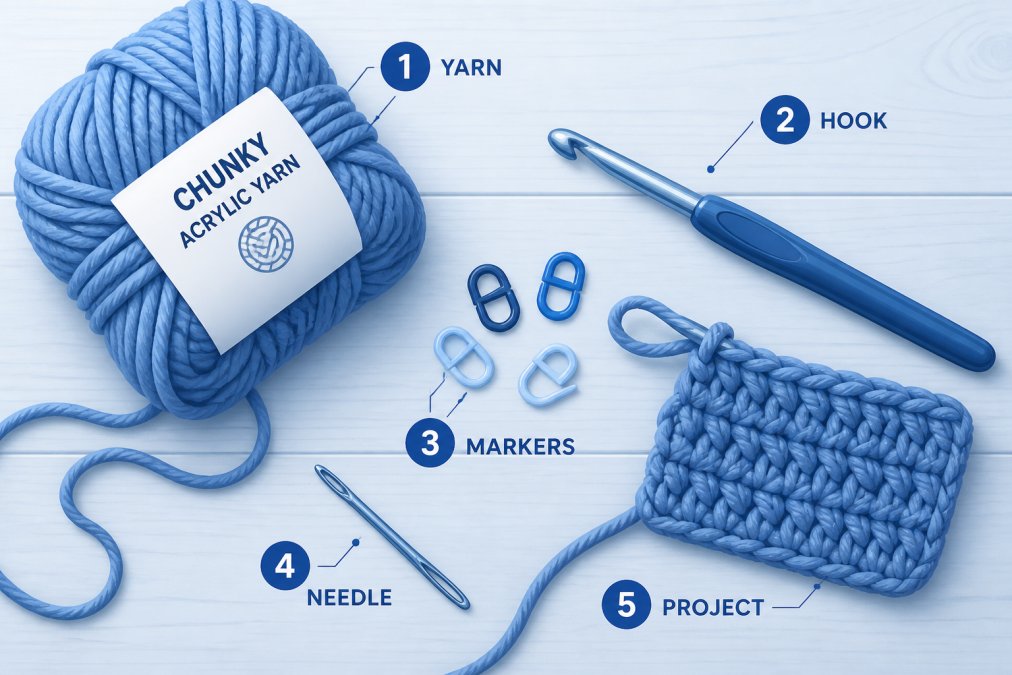
A small zippered pouch holds one skein, a 9mm hook, three stitch markers, a tapestry needle, and a folded printout of your pattern. That entire kit fits in a jacket pocket. TSA allows crochet hooks in both carry-on and checked bags, as confirmed by TSA's prohibited items list.
2026 Crochet Color Trends and Seasonal Project Ideas
The 2026 crochet color palette in the US crafting community leans toward warm earth tones, muted terracottas, sage greens, and dusty blues, with a notable resurgence of cream and off-white as neutral bases. These tones work particularly well for home décor projects like pillow covers and market bags.
Seasonal project planning keeps your fiber content matched to the season you're working in and ensures your finished objects are seasonally useful. Start temperature blanket strips in January, work on lightweight cotton projects through spring and summer, and shift to bulky wool blend scarves and ear warmers from September onward. The temperature blanket challenge has grown into one of the most active communal crochet projects in the US crafting community. By December, makers who started with shaky tension control in January typically produce noticeably more even fabric.
For color palette selection on any project, choose three colors maximum: a main color, a contrast, and a neutral.
Budget-Friendly Project Planning and Yarn Stash Busting
Budget-friendly crochet project planning starts with one rule: buy yarn for a specific project, not for a hypothetical future project. For beginners, a practical starting kit costs far less than most assume. A 9mm hook, a set of stitch markers, a tapestry needle, and two skeins of bulky acrylic yarn will cover the first five projects on this list. Visit BlockToGo's shop for curated pattern options that specify exactly what materials you need before you buy anything.
Stash-busting strategies that actually work:
- Sort existing yarn by weight first, then by fiber content
- Identify which projects use each weight category
- Work through one weight category completely before buying new yarn
- Use the striped market bag pattern for any worsted-weight scraps under 100 yards
Free patterns from established sources like Lion Brand's free beginner crochet pattern collection cover all the basics and are a legitimate starting point before investing in paid patterns. Paid patterns typically offer more unique designs, clearer photography, and better stitch-by-stitch instruction formatting.
The real cost in crochet is the yarn. Acrylic yarn is the most budget-friendly option and performs well for every project on this list. Cotton yarn costs slightly more but is the better choice for dishcloths and market bags where structure and washability matter.
Accessibility-Focused Patterns and Common Beginner Mistakes to Avoid
Accessibility-focused crochet patterns are designed to accommodate a range of physical needs, including limited hand strength, reduced grip, and low vision.
For makers with limited hand strength, bulky yarn on a large hook requires significantly less grip force than fine yarn on a small hook. Ergonomic crochet hooks with padded handles reduce hand fatigue over long sessions. For low-vision makers, high-contrast yarn colors make stitches easier to identify. Avoid variegated or self-striping yarns in early projects.
Common beginner mistakes and their fixes:
- Uneven tension: Practice holding the yarn consistently. Your non-dominant hand controls yarn tension, not your hook hand.
- Twisted foundation chain: Lay your chain flat before working the first row back.
- Skipping the gauge swatch: For sized items, this always matters. For flat decorative items, it rarely does.
- Losing stitch count: Count at the end of every row for the first ten rows. Use stitch markers at every tenth stitch on long rows.
- Not weaving in ends securely: Thread your tapestry needle through the back loops of at least five stitches in two directions.
Your first five projects will look noticeably worse than your sixth. That's not failure. That's how tension control develops.
Frequently Asked Questions
What is the easiest thing to crochet for a beginner?
A single-crochet dishcloth or a simple scarf ranks among the easiest beginner crochet patterns because both use only the chain stitch and single crochet in straight rows. You work a foundation row, then repeat the same stitch across each row with a turning chain at the end. Bulky acrylic yarn on a size J or K hook makes stitches easy to see, keeps tension forgiving, and lets you finish the project in just a few hours, which builds confidence fast.
What are the basic crochet stitches for beginners?
The four stitches every beginner needs are the slip knot, chain stitch, single crochet, and half-double crochet. Master those four and you can complete the majority of beginner crochet patterns. The slip knot anchors your yarn to the hook. The chain stitch forms your foundation row. Single crochet builds dense, sturdy fabric. Half-double crochet adds height and drape. Once those feel natural, the double crochet and yarn-over techniques open up a much larger stitch library.
How do you read a crochet pattern for beginners?
Start by checking the skill level, yarn weight, and hook size listed at the top. Then read through the entire pattern once before you pick up your hook. Crochet patterns use standard US abbreviations: ch means chain, sc means single crochet, and dc means double crochet. Numbers in parentheses show stitch counts at the end of a row. Asterisks mark sections you repeat. Keeping a row counter and stitch markers nearby prevents losing your place, especially on longer projects like a baby blanket.
How do I choose a beginner crochet pattern that I'll actually finish?
Pick a pattern that matches your current skill level, uses bulky or worsted-weight yarn, and produces a finished item in under five hours. Functional projects like dishcloths, coasters, or a small tote bag stay motivating because you can see a clear use for them. Patterns labeled 'beginner-friendly' with step-by-step instructions and a low stitch count are the safest starting point. If you travel frequently, also check that the project fits in a project bag so it goes with you and gets finished.
What supplies do I need to start crocheting?
You need a crochet hook (a size I-9 or J-10 is a good all-around starting size), one skein of medium or bulky weight yarn in a light color so stitches are easy to see, a tapestry needle for weaving in ends, and a pair of scissors. Stitch markers and a row counter are optional but genuinely helpful for keeping track of your work. A project bag keeps everything together, which is especially useful if you plan to crochet while commuting or traveling.
What are some common mistakes beginners make when crocheting?
The most common mistakes are skipping the gauge swatch, crocheting into the wrong part of the stitch, and accidentally adding or dropping stitches at the ends of rows. Tight tension is also frequent among beginners and makes the hook hard to push through loops. Counting stitches at the end of every row catches errors early. Using a light-colored yarn and a hook with a comfortable grip reduces most of these problems before they compound into a project you want to abandon.
Starting a new craft is genuinely difficult when you're working from scattered, generic instructions that weren't designed with your lifestyle in mind. BlockToGo addresses this directly with travel-friendly patterns built for real life: easy-to-follow instructions, practical functional designs, and projects sized to fit in a carry-on. If you're ready to actually finish a crochet project instead of abandoning it at row three, get started with BlockToGo and make something you'll use every day.