
Table of Contents
- Why Crochet Hook Alternatives Matter for Travel
- TSA Crochet Hook Rules and What's Actually Allowed
- Essential Travel-Friendly Tool Alternatives
- Best Travel Crochet Projects for Portable Crafting
- Portable Yarn Storage Solutions for Carry-On Luggage
- Ergonomic Considerations When Crafting in Confined Spaces
- Digital vs. Analog Patterns: Choosing What Works for Travel
- How to Avoid Common Travel Crafting Mistakes
Last Updated: August 8, 2026
Why Crochet Hook Alternatives Matter for Travel
Traditional metal crochet hooks fall into a TSA gray zone that varies by airport and agent. Some officers wave them through; others confiscate them. This uncertainty makes many travelers leave their projects at home.
But crochet hook alternatives for travel have evolved dramatically. You no longer have to choose between your hobby and your luggage. BlockToGo specializes in helping makers on the move with travel-friendly crochet patterns and kits designed specifically for people who want to create functional home décor while traveling.
The real opportunity is choosing the right alternative that matches your travel style, project complexity, and personal preferences. This guide covers the alternatives that actually work, backed by real TSA guidelines and practical testing, so you can craft confidently wherever you travel.
TSA Crochet Hook Rules and What's Actually Allowed
The TSA permits crochet hooks in carry-on and checked baggage, but final determination rests with the security officer at the checkpoint. Standard aluminum or plastic crochet hooks are almost always allowed through security.
The confusion arises because scissors have strict restrictions: blades longer than 4 inches are prohibited in carry-on luggage. This is where most travelers get stopped, not because of the hooks themselves.
The safest approach is to avoid anything that resembles a weapon or cutting tool. Bamboo or plastic hooks face zero scrutiny. Metal hooks in the 2.0mm to 6.0mm range are standard and accepted. Yarn snips with blades under 3 inches and no finger openings are approved.
If you're nervous, check ahead with your airline or use the TSA's official "Ask TSA" social media service. A quick photo of your specific tool kit gets a definitive answer before you pack.
Essential Travel-Friendly Tool Alternatives
When you can't bring traditional crochet hooks or want backup options, several alternatives let you keep crafting without compromising security or luggage space.
Multi-Tool Kits for Knitters and Crocheters
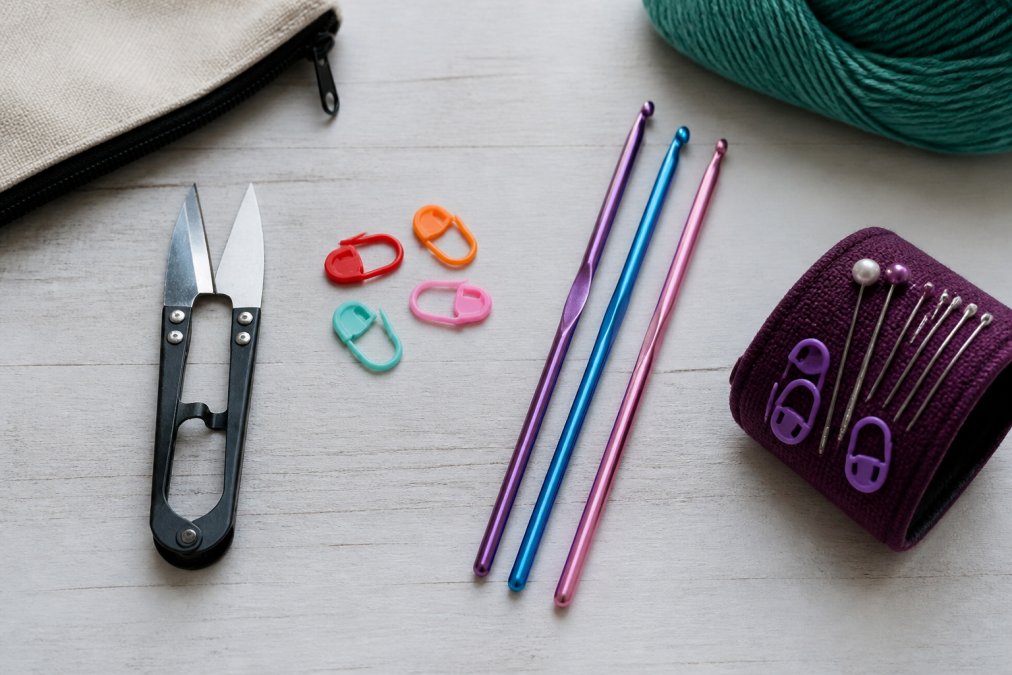
The Knit Kit from Summer Camp Fibers combines over 10 essential accessories, scissors, tape measure, stitch counter, double-ended crochet hook, stitch markers, point protectors, and yarn cutter, into a single compact case. Everything is TSA-approved, which removes the guesswork entirely.
What makes this kit valuable is consolidation. Instead of hunting for five different small tools scattered across your carry-on, you have one organized case. The trade-off is that multi-tool kits aren't customizable. You get the tools included, not the ones you'd personally choose.
TSA-Approved Cutting and Notions Tools
The Cocoknits Yarn Snip is forged from a single piece of steel with a slim design (no finger openings) and is explicitly TSA-approved with blades under 3 inches. It includes a leather cover that protects your project from the pointy ends.
This tool is ideal if you already have hooks and just need a way to cut yarn cleanly. It's lighter than scissors and takes up almost no space. For broader notions, nail clippers work surprisingly well as a backup cutting tool and are completely TSA-friendly.
Magnetic Tool Organization Solutions
The Cocoknits Maker's Keep is a magnetic slap bracelet that keeps small metal tools secure and accessible. Stitch markers, tapestry needles, and other metal notions cling to the magnetic face. The underside includes a 4-inch ruler for checking gauge.
This solves a specific travel problem: losing tiny essential tools. On a plane, a stitch marker that falls is gone. The Maker's Keep keeps everything visible and within reach. The limitation is that it only works with metal tools.
Best Travel Crochet Projects for Portable Crafting
The best travel projects are simple enough to work on without constant pattern checking and small enough to finish within a reasonable timeframe.
Beginner-Friendly Patterns That Finish Fast
Simple amigurumi (small stuffed toys) are ideal for travel. They use basic single crochet and increases/decreases, which means you can work on them almost automatically once you've established the pattern. A small amigurumi takes 3 to 6 hours of work.
Dishcloths and washcloths are another excellent choice. They're flat, use straightforward stitches, and most patterns are less than 20 rows. When you finish, you have something immediately useful.
BlockToGo specializes in travel-friendly patterns specifically designed for makers on the move. Their patterns are engineered for quick completion and practical results, functional home décor you can actually use.
Functional Home Décor You Can Complete Mid-Trip
Coasters are underrated travel projects. They're small (4x4 inches typically), finish in 30 minutes to an hour, and are genuinely useful. Small organizers, yarn bowls, or cord holders combine practicality with satisfying completion. Plant pot covers are another smart choice, they're cylindrical, forgiving for gauge variations, and useful immediately.
The key is choosing projects with defined endpoints. Avoid open-ended items like blankets or sweaters.
Portable Yarn Storage Solutions for Carry-On Luggage
How you store yarn determines whether your project stays organized or becomes a tangled disaster.
Compact Project Bags That Double as Carry-On
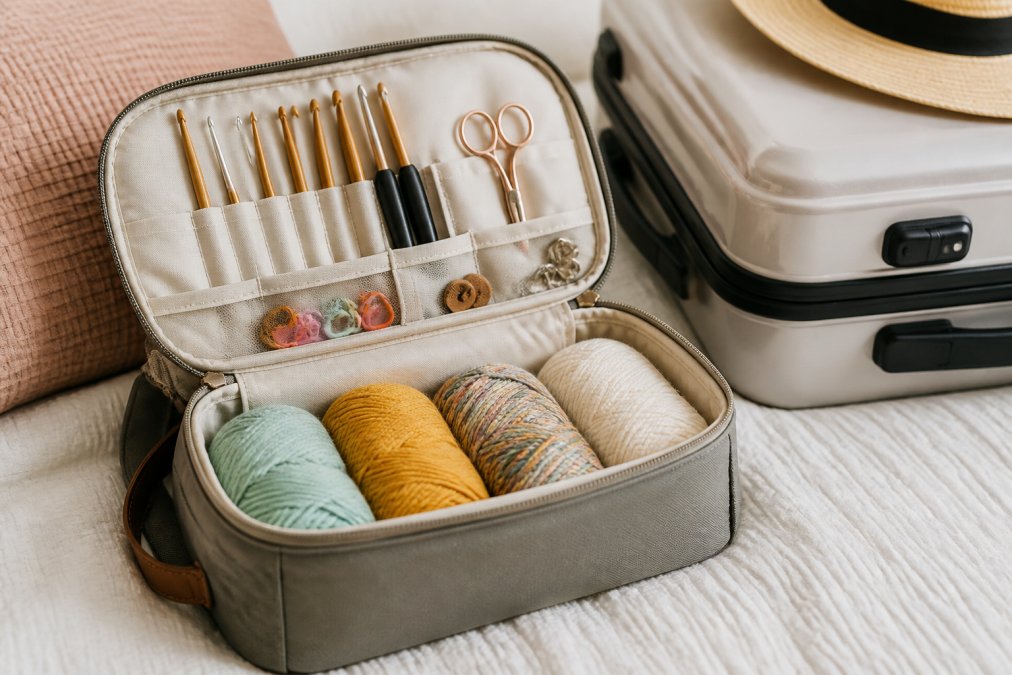
The Atenti Overnighter is a roomy project bag with a 25-inch zippered opening, full water-resistant lining, and double straps. The water-resistant feature matters: if your water bottle leaks, your yarn stays dry. It's stylish enough to carry as a regular tote.
For minimalists, the Hobby Lobby Crochet Hooks & Travel Case Set includes a soft-lined travel case (7.25 x 5 inches) designed specifically for hooks and notions. The FINPAC Sewing and Craft Supplies Storage Tote is a large-capacity organizer with clear pockets so you can see exactly what you have.
Space-Saving Yarn Organization Methods
Center-pull yarn cakes prevent yarn from rolling around your bag. Wind your yarn into a center-pull cake before you travel. Ziplock bags work well: separate each yarn color into its own small bag to prevent tangling and protect yarn from moisture.
Yarn bowls serve double duty: they hold your yarn while you work and organize it in your bag. Some bowls are collapsible, which saves space when packing. The principle is simple: contain each element separately so yarn, hooks, and notions don't mingle in your bag.
Ergonomic Considerations When Crafting in Confined Spaces
Airplane seats weren't designed for crafting. Smaller hooks (2.0mm to 4.0mm) are easier on your hands during extended work sessions in tight spaces. Larger hooks require bigger hand movements, which is uncomfortable with limited room.
Intentionally loosen your tension slightly before traveling. This reduces hand strain and makes the work feel less effortful. Take breaks every 30 to 45 minutes. Stand up, walk, and stretch your shoulders and wrists.
Consider ergonomic hook handles if you're sensitive to hand fatigue. Thicker handles reduce strain. The Coopay 58 PCS Crochet Hooks Set includes ergonomic soft-grip hooks specifically designed for comfort.
Digital vs. Analog Patterns: Choosing What Works for Travel
Printed patterns are reliable and don't require batteries. You can write notes directly on them. The downside: they take up physical space.
Digital patterns on your phone or tablet are space-efficient. One device holds dozens of patterns. You can zoom in on unclear instructions. The downside: your device needs battery and internet or downloaded files.
The hybrid approach works best: download your pattern as a PDF to your phone and bring a printed backup. This gives you the efficiency of digital access with the security of a physical copy.
How to Avoid Common Travel Crafting Mistakes
Overpacking tools. Bring three hooks maximum, one yarn cutter, and stitch markers only if necessary.
Choosing projects that are too complex. A pattern requiring constant reference becomes frustrating on a plane. Choose patterns you could work on without looking at instructions.
Not testing your setup before traveling. Spend an evening at home working with your travel kit to discover if something doesn't work.
Ignoring tension and gauge. Travel stress and unfamiliar working positions change how tightly you crochet. Make a small swatch to confirm your stitches match the pattern.
Bringing yarn that's too delicate. Choose sturdy, forgiving yarn. Acrylic is reliable for travel. Avoid novelty yarns or anything requiring gentle handling.
Not securing your project. Use point protectors or stitch markers to secure your stitches when not actively working.
Forgetting airline-specific rules. Some airlines have restrictions beyond TSA guidelines. Check your specific airline's policy.
Travel crafting doesn't require expensive equipment or complex projects. It requires intentional choices about what you bring, what you make, and how you organize your supplies. BlockToGo makes this easier by offering travel-friendly crochet patterns and kits with clear, beginner-friendly instructions specifically designed for makers on the move. Their patterns focus on functional home décor you can complete during a trip and actually use when you get home. Start with one of their patterns, pair it with a portable project bag and TSA-approved tools, and you'll discover that travel crafting transforms flights and hotel downtime into productive, creative hours. Get started with BlockToGo and turn your next trip into an opportunity to create something beautiful.
Frequently Asked Questions
Can you bring crochet hooks and yarn through TSA checkpoints?
Yes, you can bring crochet hooks and yarn through TSA checkpoints in both carry-on and checked luggage. Crochet hooks are permitted because they're not sharp enough to pose a security risk. Yarn is also allowed with no restrictions. However, avoid metal scissors or hooks with very sharp points, and check with your airline about specific tool restrictions. Always pack your crochet hook alternatives and supplies in your carry-on project bag for easy access during your flight.
What are the best travel crochet projects for beginners?
The best travel crochet projects for beginners are simple, portable items like dishcloths, coasters, and small amigurumi that you can complete in a few hours. Look for patterns with basic stitches, minimal color changes, and straightforward gauge requirements. BlockToGo offers beginner-friendly patterns specifically designed for travel, with clear instructions that reduce stress. Choose projects that fit in your carry-on luggage and don't require complex stitch markers or frequent pattern referencing, so you can focus on enjoying your crafting experience while on the go.
How do I pack crochet supplies in a carry-on without taking up too much space?
Use a compact project bag with clear pockets to organize your yarn skeins, crochet hook alternatives, and notions. Roll yarn into center-pull cakes instead of keeping bulky skeins, and store small tools in ziplock bags or magnetic organizers. Keep your pattern digital on your phone or tablet rather than printing it, and pack only the yarn colors you'll use for one project. Portable yarn storage solutions like the Atenti Overnighter or FINPAC organizer are designed to maximize space while keeping everything accessible during your flight.
What crochet hook alternatives work best if I can't bring my regular hooks?
TSA-approved crochet hook alternatives include bamboo or plastic travel hooks, multi-tool kits like The Knit Kit, and compact keychain hooks for emergency fixes. Cocoknits Yarn Snip provides a TSA-safe cutting tool, while the Cocoknits Maker's Keep magnetic bracelet keeps metal stitch markers secure. These alternatives are designed to be lightweight, portable, and airplane-safe, allowing you to continue your projects without worrying about security restrictions. Choose alternatives based on your project needs and whether you prefer ergonomic grips or ultra-compact designs.